Kids with punk hairdos testing out vibrating vests made from inner tubes? No, you're not dreaming, this scene actually took place last week. At Hellfest, a team of Learning Planet Institute students put to the test the prototypes developed as part of ’À portée de scène«, a project designed to make festivals more accessible. The project was conceived at MakerLab, as was the FORVIA Disability Hackathon held a week earlier. Meet the artisans of a culture of accessibility made by Learning Planet Institute.
The MakerLab, cradle of inclusive innovation
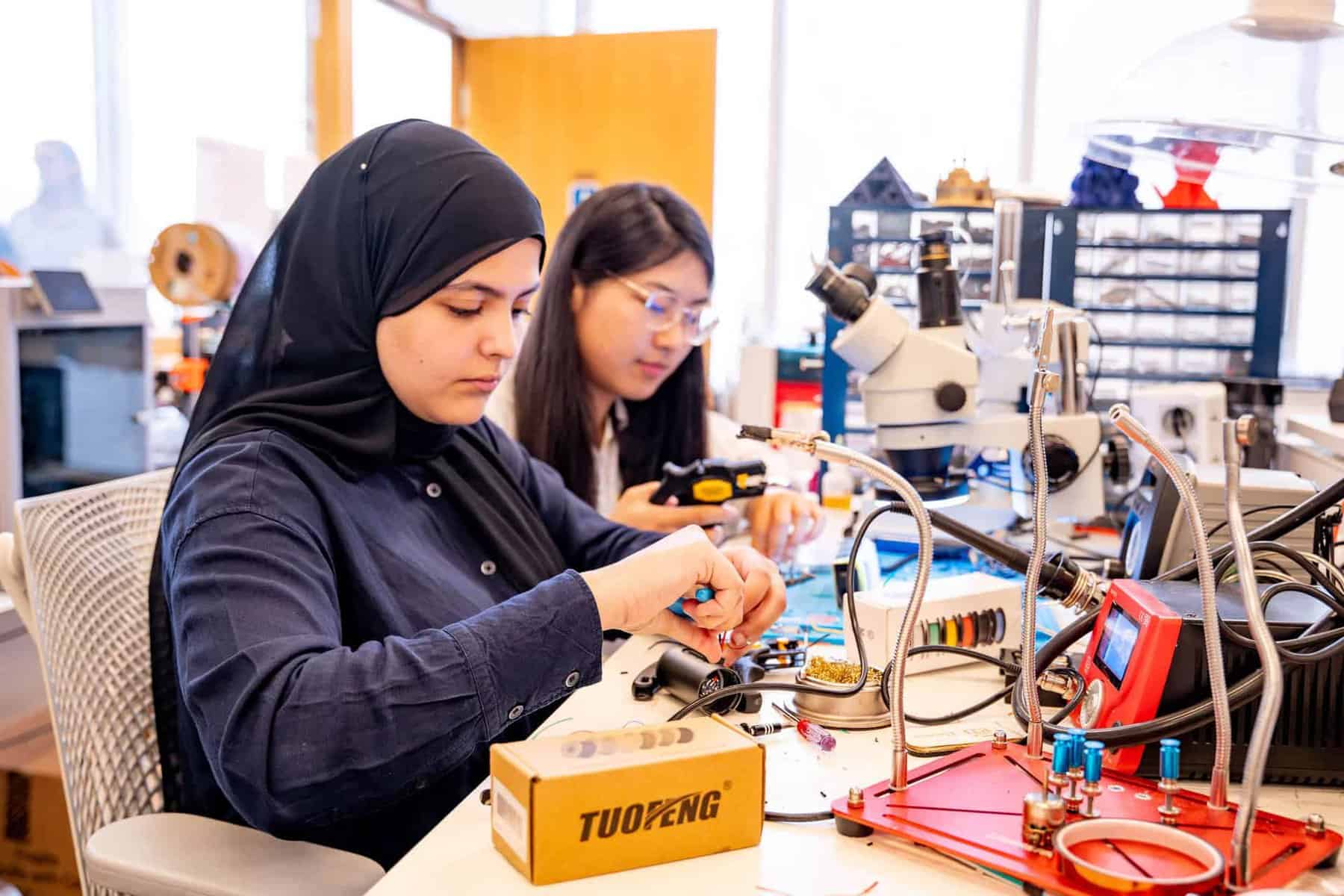
In 2012, the idea of opening a FabLab was born at the Learning Planet Institute. «Initially, the FabLab is an interdisciplinary place that allows everyone to become aware of the possibilities of creating and making things using digital tools.», explains Kevin Lhoste, research and teaching manager and head of the MakerLab, the name given to the Institute's FabLab.
«Today, Learning Planet Institute students come to MakerLab as part of modules. Others, who participate in the Summer School, They also come to work here, he continues. The MakerLab's teaching method is pragmatic: it mixes frugal innovation - which consists in meeting a need in a simple way with a minimum of resources - with the «hacker» spirit, an art of resourcefulness and the desire to learn. «Many fields don't seem accessible to young people, but here we're developing tools that give them access to exploring a wide range of projects.. Artificial intelligence and Arduino technology (an open-source prototyping platform) are among these low-cost tools.»
Accessibility, a key issue for the Learning Planet Institute
MakerLab has always worked to serve the Sustainable Development Goals (SDGs), and accessibility is one of its core values. diversity and inclusiveness by the Institute.
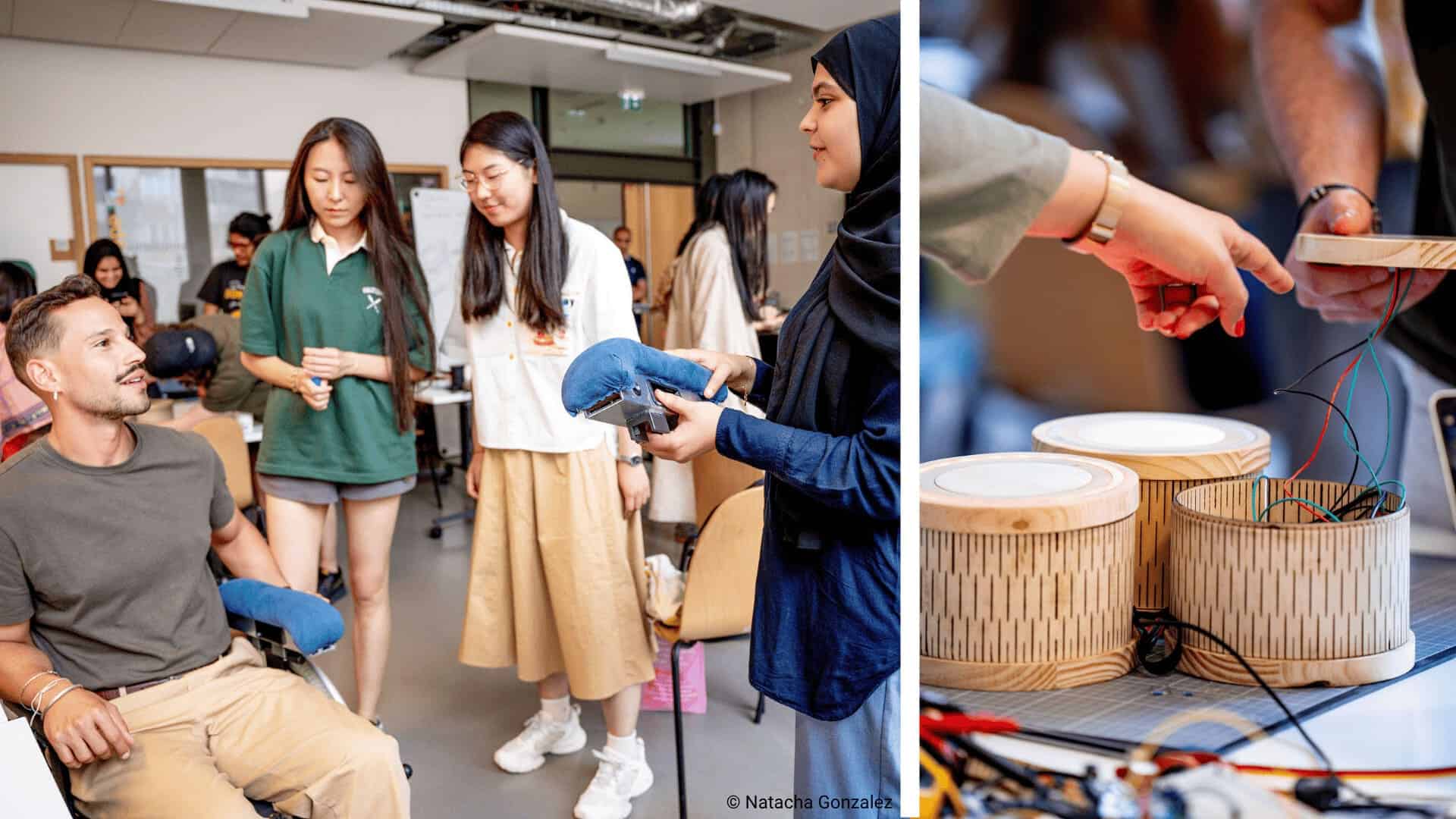
«Accessibility is an interesting topic, since it's easy to find concrete problems and solutions that can help people with disabilities. It also allows students to be confronted with the realities of disability».», adds Kevin. Mentors with disabilities, such as Yousra, who uses a wheelchair, or Diego, who has a prosthetic hand, come to meet the students and talk about their daily lives. For example, after talking to Diego, a team of young people thought about his needs and then developed a 3D device to enable him to tie his shoes independently.
In 2025, two new projects were born at MakerLab: «À portée de scène», which works to make music festivals more accessible, and the «Disability hackathon FORVIA», to imagine useful tools for the daily lives of people with disabilities.
«À portée de scène»: making festivals accessible
«À portée de scène» was launched last January thanks to the decisive support of the Malakoff Humanis Handicap Foundation which has been working for 8 years to make cultural venues more inclusive and measure the social impact of its actions. This project mobilizes the creativity and innovative strength of students, who create and field-test new solutions to accessibility challenges. «There's a real coordination challenge around this project, since we're mobilizing young people as well as foundations, higher education establishments, partners, festivals, disability experts, concerned individuals and committed companies*.», explains project manager Étienne Karlen. «These are structures that aren't necessarily used to working together, so it's very rich.», he explains.
«The project was structured in four phases, says Étienne. «First of all, a state of the art is carried out, then a challenge is identified by a festival (what has been done, what remains to be done to make places accessible). This challenge is then linked to one of the participating schools and transformed into a concrete problem to which a range of solutions can be applied.»
A week-long hackathon was held last March with students from the Master of AIRE, and the projects selected by the jury were prototyped by the MakerLab team for testing at the Hellfest in June. Three projects were tested: 1) a sensory rest area with furniture, tactile objects and a compressive seat (which reproduces the effect of a cuddle, and which was tested beforehand by two young autistic people from the’IME Cour de Venise), 2) a wheelchair periscope with screen and augmented reality glasses, tested by Pierre Laurian, president of the Dux foundation, 3) vibrating vests, made from balloon inner tubes, which allow you to feel the music in your body.
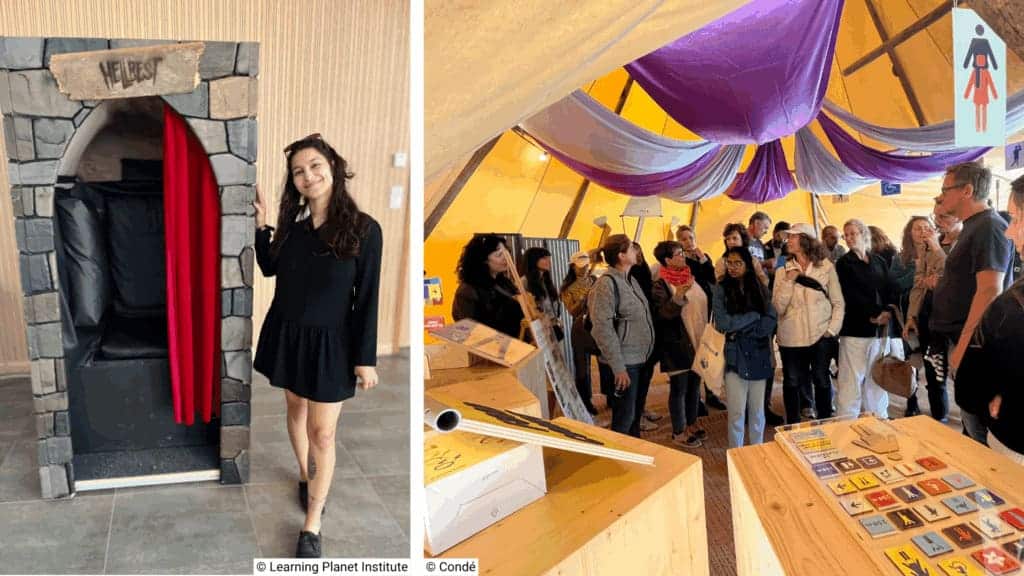
«With the Pôle Léonard de Vinci, we have also worked with the Eurockéennes de Belfort, Jazz à Vienne and Jazz in Marciac. At the annual Pôle Leonard de Vinci, some 100 of the 1,300 first-year students worked on gamification projects at these festivals, and 160 students from the’IIM Digital School have even gone on to prototype digital solutions as part of a semester-long project. Students from Condé also worked this year on accessible and sustainable signage, which they were able to submit to the festival team. We Love Green.
The student projects were evaluated by a panel of judges including: accessibility experts - Denis Leroy, founder and president of Régie Access, as well as the IME Cour de Venise - and the teaching teams from partner schools. AD Education Foundation, but also members of Companies for the City. A particularly promising response, which seems to pave the way for a bright future for the «À portée de scène» project.
Consolidation of feedback in September will enable us to assess the relevance of the tools made available, and to consider the possibility of rolling out some of them.
The FORVIA Disability Hackathon: innovating for everyday life
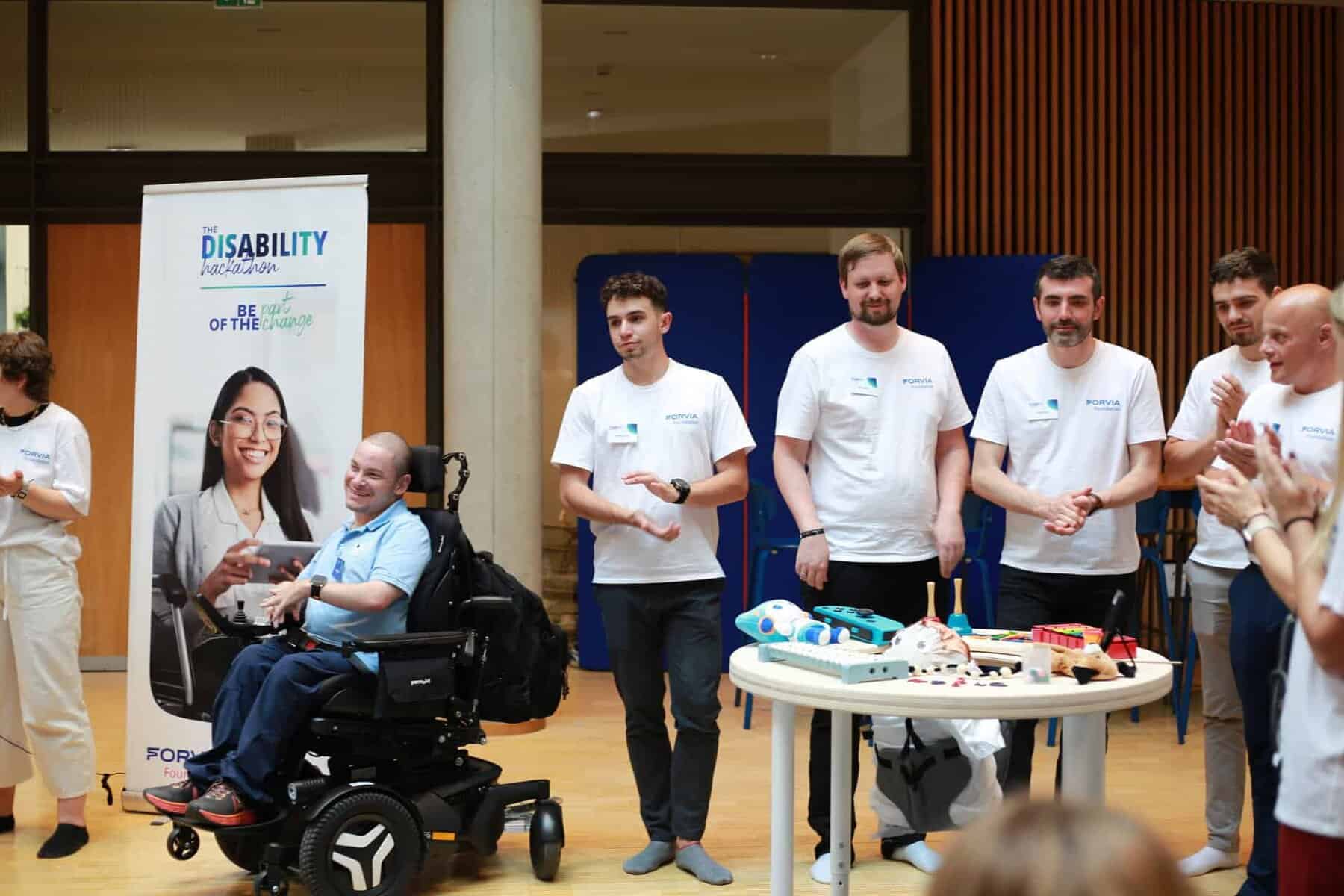
In 2025, another accessibility project was launched, led by project manager Jade Borsoi. The FORVIA Foundation wanted to mobilize its employees around the issue of disability, so that they could put their skills at the service of this universal cause. The MakerLab approach (frugal innovation, collective work, concrete solutions to the challenges faced by people with disabilities) echoed the Foundation's vision, and this is how the FORVIA hackathon on disability came about.
30 FORVIA employees with a wide range of expertise (quality, HR, R&D, IT, etc.) worked on challenges with the support of ten MakerLab mentors, including students from the Learning Planet Institute. Three challenges, submitted by beneficiaries, had been selected in advance: the design of a leisure equipment for the 8-year-old daughter of an employee with bifrontal polymicrogyria, the design of a reversing camera, and the creation of a voice-activated remote control for the medical bed of Édouard, a tetraplegic in a wheelchair and friend of an employee.
«The participants were very enthusiastic. They appreciated the venue, the approach, the welcome and the mentoring, but also the opportunity to meet other people from their company.», explains Kevin Lhoste. «Project owners were particularly touched by the collective mobilization around their day-to-day problems».», he continues. The prototypes are now being finalized so that they can be used by the beneficiaries, and the experiment will be made public, through an online space and relayed via expert networks, with potential outside users, some of whom are already interested in the reversing radar.
From festivals to the workplace to the home, MakerLab projects are undoubtedly moving in the direction of a more accessible society for people with disabilities. « Today, we're looking to create a sustainable hackathon model that can mobilize large-scale »enthuses Étienne Karlen.
Learn more
*Project partners :
- « Within stage range »in partnership with Malakoff Humanis Handicap Foundation, the AD Education Foundation, higher education institutions (Condé, Pôle Léonard de Vinci), disability experts (Entreprendre pour Aider, Régie Access, IME Cour de Venise, CAP SAAA, CNCPH, Kerpape endowment fund, Fondation Saint-Pierre), festivals (Hellfest, Jazz à Vienne, Jazz in Marciac, Les Eurockéennes de Belfort, We Love Green), and committed companies (Les Entreprises pour la Cité, Admical)
- « Disability hackathon FORVIA »in partnership with FORVIA Foundation.
Company, foundation, university or festival :
- Contact us to join the movement, bring your accessibility challenges, the expertise of your employees or the energy of your students... for a more accessible world!
- Become a patron of one of our committed projects.
An article written by Marie Ollivier
Thanks to Kevin Lhoste and Étienne Karlen for answering our questions.